
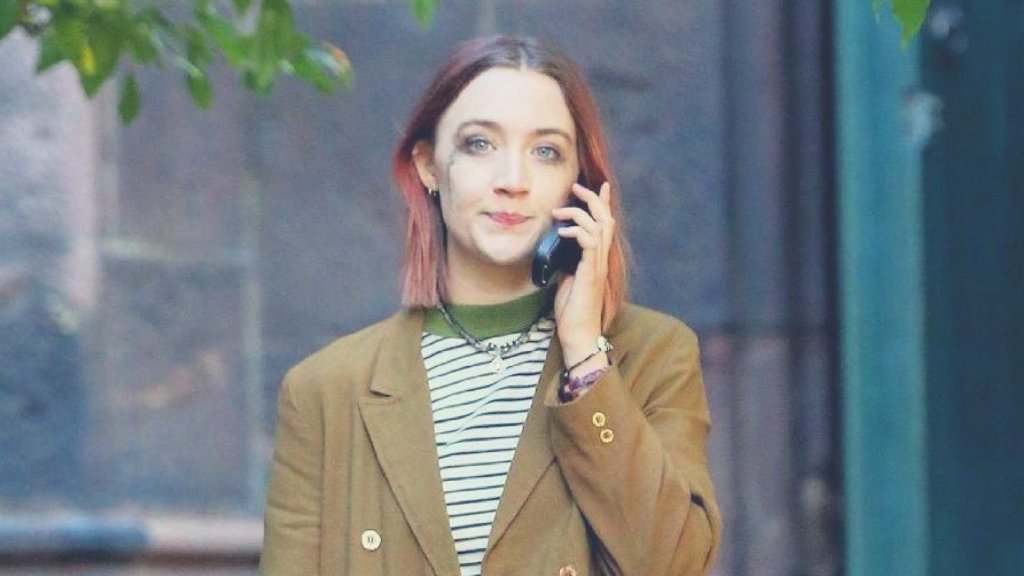
It was necessary to watch this twice before I knew how much I liked it. I had been told it was a perfectly fine, but insignificant film that was largely forgettable. So I was confused on first viewing to find the dialogue bitingly perceptive, the characters full and rounded, and the subject not small but essentially personal. And funny! It’s a funny film – mostly at the expense of nuns and mothers. The second viewing confirmed for me this was not just a mood or tiredness reaction; I laughed even more, related twice as much, and came away feeling entirely connected to the wonderful “smallness” of Lady Bird”.
Set in 2002 in sleepy Sacramento, California, just as mobile phones and the internet are hitting their stride, it focuses on the rite of passage of the awkwardly rebellious Christine, who wants to be known as Lady Bird. She is far from an A-grade student at the catholic school she attends, although smart. She has far from an ideal home life, although loving. She is pretty but not beautiful; liked but not popular. Essentially, she is an average teenager struggling to find out who she is and what she wants.
What separates that uninspiring set up from a standard coming of age comedy is the two basics of a good film – a great script and great direction. The one person responsible for both is the exceptionally talented Greta Gerwig, who deservedly received a double Oscar nomination for her work. The film also claimed nominations for the two other women at the centre of this importantly feminine movie: the underused Laurie Metcalf as Lady Bird’s hard nosed mother, who has trouble expressing her love, and the so-good-it-is-getting-ridiculous Saoirse Ronan, as the titular anti-hero we both instantly like and find infinitely frustrating in turns.
Friendships, romances and schoolwork are explored in episodic scenes that mesh together well as a whole because it is all about how Lady Bird relates to her small world and the people in it; looking to the stars and the ambition of getting out to New York, whilst forgetting to respect and take care of the really important stuff that is actually happening in the moment. Lucas Hedges and, later, Timothée Chalamet, two of the best young support actors going for the last few years, give terrific colour to her experience of first love and sex; and Beanie Feldstein, as best friend Julie, steals several scenes with her guileless good nature and affecting smile.
But it is the firework relationship of mother and daughter that really makes this ode to youth sing. Every scene and conflict, minor and major, between the two of them crackles with truth and angst; one woman who expresses herself too much, and one who can’t express herself enough, clashing in a war of words that you have to pay attention to if you don’t want to miss real pearls! “I just want you to like me”, “Of course I love you”, “yes, but do you like me?“, for example. So simple, but it stays with you long afterwards, ringing bells with anyone who ever had any kind of conflict with a parent.
What I really like about this film is that it never tries to over-reach, or wring more comedy, or emotion, or meaning out of a scene that isn’t naturally there. In moments it seems to drift a while, but that is OK, because sometimes life does drift. It’s like a Kelly Reichardt film with the sass and wit of Juno and the earnestness of Good Will Hunting. There is also a nice soundtrack going on, including the essential hits of 2002 such as Alanis Morisette and Justin Timberlake – weird to see them as nostalgic already, but of course they are. Perhaps there isn’t enough of that to leave the impression the music is a big part of the whole package, but it is there, again, in a small way.
The gender of directors and writers isn’t always something I bother to ask, but in the context of female directors getting more attention, critical acclaim, and even just work and equal pay, Lady Bird is a hugely significant film. I have yet to see Little Women, but I am excited to do so on the back of this. Gerwig is still only 36, and Ronan is (amazingly) only 25. We could be on the verge of a very special collaboration that ends up being considered among the very best in cinema history. So, no pressure.
I feel like I have waxed lyrical too much to reflect accurately my overall impression of it, however. I should try and say something bad about it… Well, that is honestly tough. I guess in artistic terms it doesn’t aim for anything too spectacular visually; the camera is merely capturing the dialogue and scenes adequately, without fuss. And, I guess, some of the one liners that are there for comic purposes don’t always land 100%. When they do it is great! But there is some inconsistency there. Otherwise, you kind of have to let it go and say it is as good a film of this size, scope and subject can be; and I imagine time will judge it quite kindly on reflection – just like Sacramento.
Decinemal Rating: 74
 The Wasteland