
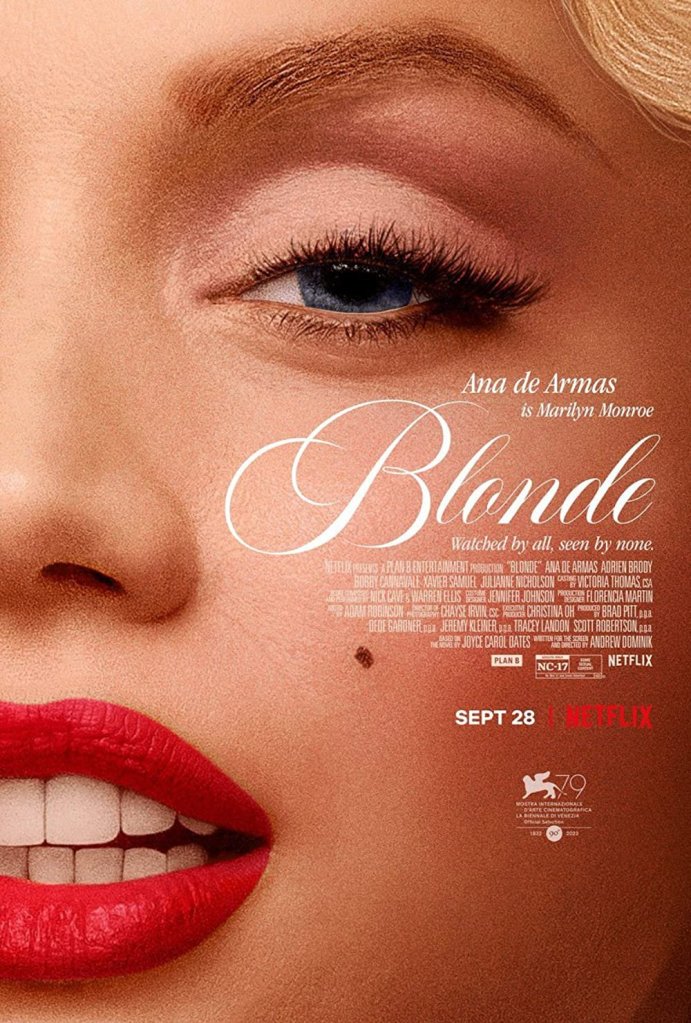
This is not a happy dream. It is also not, strictly speaking, a biopic. It is a fiction (an imagined nightmare) based on a novel by Joyce Carol Oates. It was nominated for the Pulizer prize in 2001, and at over 700 pages long, discusses in depth the themes of conspiracy, misogyny, professional abuse and psychological difficulties based on abandonment and Freudian father figure issues, all of which (it has been well documented) have been part of the Marilyn Monroe mythology for decades.
That it directly attaches itself to the name of Marilyn, and doesn’t try to hide the fact that it is about her life and personality, is essentially the root of many problems and issues some fans and protectors of Marilyn’s legacy have had with this movie. There is indeed a strong argument that because it was exploitation, sexualisation and misrepresentation that drove her to suicide in 1962, isn’t it only adding to that to use her name and image in this way; to explore issues that may or may not be based on truth, but rumour alone? Is it still degrading and insulting to her memory to show these things? Basically, is this a valuable work of art that strives to better the plight of abused women, or does it merely spit on her grave and add fuel to the fire?
Well, judging on the excessive amounts of 1 and 2 star reviews left by vitriolic viewers on IMdb, Rotten Tomatoes and other reputable online sources it seems a lot of folk believe it is the latter. Published reviews from official newspapers and professional critics have also been very cautious to point this out, even if ultimately they end up praising its many virtues. And there are many, many virtues. The trouble is, maybe this kind of arthouse fare isn’t for the Netflix mass audience (yet)? I’m sure anyone who chose to visit a cinema intentionally to see it got a lot more out of it. Especially as it is harder in that arena to turn it off and walk away before it has concluded and postulated its full message.
We’ve seen it before. It reminds me of the times Lars Von Trier or Gaspar Noe released… well… anything! Or Malick’s The Tree of Life (not gratutiously sexual or violent but divisive nontheless) , or Stone’s Natural Born Killers, or any one of Tarantino’s blood-fests. The uproar is usually from an immature conservative minority who confuse the artistic representation of something awful for a glorification of any act of repression or violence. The two are never the same. Context of course is invaluable in distinguishing between gratuitous exploitation, titillation and genuine art. Blonde walks a very fine line here, and that is why it is troubling.
It is my personal opinion that from time to time some of Andrew Dominik’s directorial choices went too far, and often what could have been suggested in more subtle ways was shown full on in graphic detail. Sometimes, less is more, and we should be allowed to imagine horrors without having them thrust upon us and over-demonstrated in vivid visual detail. It is a choice to do so, and I am sure that choice can be justified semantically, but for me, I didn’t always need it to get the point – and those were the times when I thought, “this is what they are complaining about”. Why would you choose to aggravate an audience in this way, when other more inventive options are available to you? I’m sure he had reasons, and I look forward to finding out what they were. In short, however, Blonde was in need of an edit and the autonomy of the director disallowed it, which is a shame. A two hour version of this with the more obviously offensive parts removed might be considered a masterpiece. It remains tangibly close to being so at times.
It reminded me of one of my favourite films since the millennium, La Vie En Rose, starring Marion Cotillard. Both are about the tragic lives of entertainers, containing personal horrors, depression, substance abuse, etc. But where the French film succeeds more effectively is knowing when to pull back from the edge of darkness and morbidity and into the light. Blonde shuns the light wherever possible: it is relentlessly bleak! And by being so, leaves us craving the light and beauty and joy that must have also been in her life. Nothing about her is really celebrated, unless you look much deeper into the performance of the extraordinary Ana De Armas.
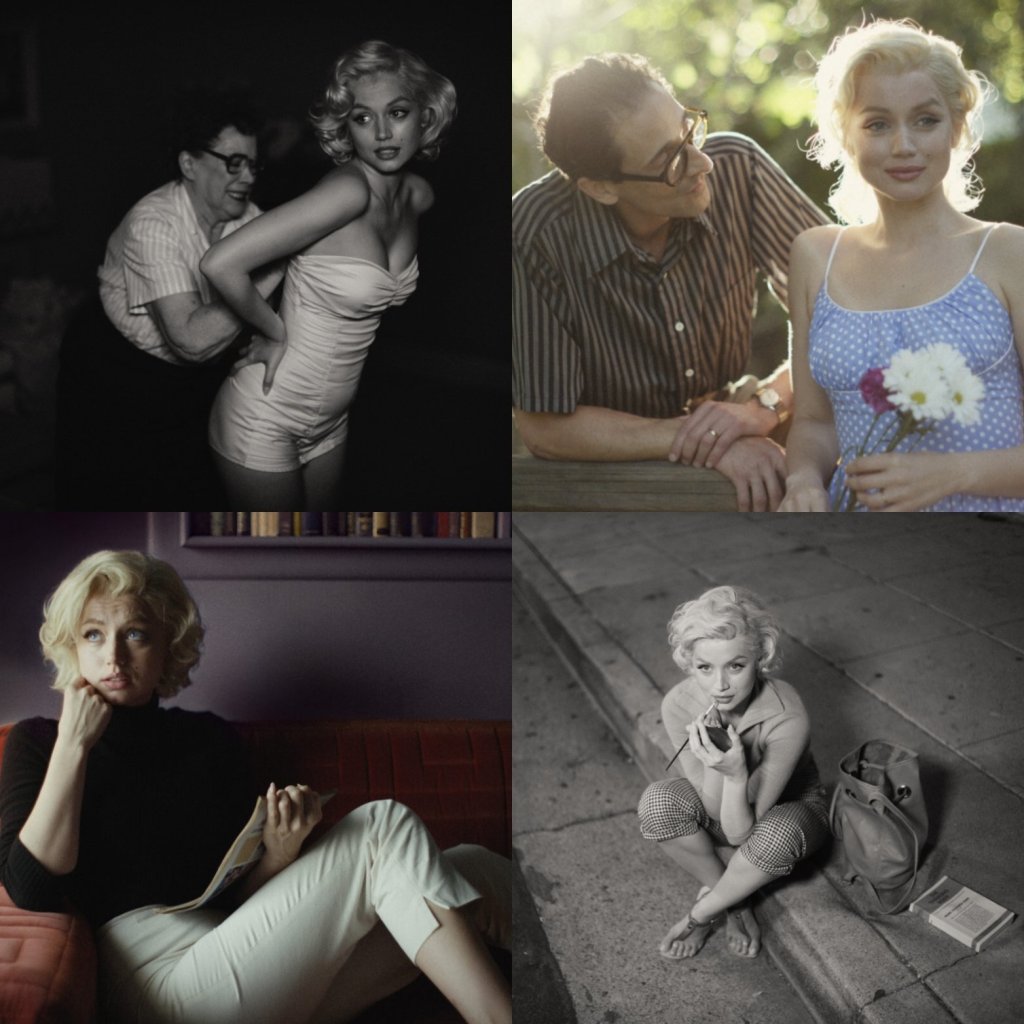
Upon further viewings, once we have acclimatised to the darkness, it may be possible to glean and distil the joy in her eyes as well as the panic, torment and misery. What is definitely there in this wonderfully charismatic portrayal by De Armas is a sense of innocence and a trusting heart. A soul prepared to be happy at every turn, only to be denied that happiness again and again. Which, of course, is the tragedy. We know where it ends, like the Titanic, it is going to sink – and the more attached we get to the beauty, the more painful that is for us as an audience.
In truth, I thought she was exquisite. What a performance! Deep, committed and mature on every level. Not for one second did I stop believing in her as a real person. And the way the iconography of her was captured and expressed: wow! The cinematography and visual flare of this film cannot be denied, no matter how vitriolic you may feel about the central subject being misrepresented. The imagery is magical. As is the Nick Cave and Warren Ellis score, which I wasn’t sure about instantly, but which I warmed to immensely and have now already downloaded in its own right.
But anyway, it is De Armas who triumphs most in the entire project – so much so she will be held blameless for all the film’s wider sins. I hope to the cinema Gods that the Academy recognise her for a nomination, at least! It is a performance good enough to win that category 9 times out of 10, and if they know what’s good for them they will see through the controversy of the film and acknowledge that. It will be interesting to see what other awards it does or doesn’t go up for. Surely not best film anywhere, although hard to see how it can be denied a nomination on the balance of its full achievement…? Technically it is very classy and often jaw-dropping. Narratively, well, not so much, but it is a dream-scape approaching Lychian proportions, so what do you expect?
A shout out to Adrian Brody as Athur Miller is necessary too. A very fine supporting performance. His presence came most welcome at a time in the film when a lift was most needed. Some of the scenes with him and De Armas were amongst my favourites. And look, there were many moments in isolation that were entirely mesmerising! The hairs on my arms stood up several times at the beauty I was beholding. And ultimately there was a magic at work here that outshone any detractions. By the final frames I was enraptured by the whole, with only a small voice in the back of my conscience saying, “yeah, but what about….?”
The whole threesome story-line with Chaplin and Robinson jnrs was drawn out too long and became superfluous. The cuts to her unborn foetus (once even speaking out loud!) and the POV of her cervix and vagina during an abortion were too much and misplaced in the tone of the whole. The JFK blow job scene was bizarre and unnecessary, containing some very misguided comedy undertones to make it more palatable or disturbing, whichever way you looked at it – that scene could and probably should have been handled another way. Also, Bobby Cannavale as Joe DiMaggio was underwritten and underdrawn; his character didn’t feel as real to me as most others.
However, offset those “mistakes” with some extraordinary moments of genius, silence, transitions, dreamlike tricks and slices of pure beauty, and you have a whole that is eventually more than the sum of its parts – worthy of more praise than criticism. It is also hugely moving. In whatever way you felt connected to Marilyn before going in, you came out more connected to her. It allows you to transpose your own issues onto hers, and that in itself is a magic trick that some of the best movies of all time have in common. I was stunned into silence for a good 10 minutes after the final frame. And that doesn’t happen every day.
I would recommend this film with caution. Don’t show it to anyone looking purely for a good time piece of entertainment. They will be lost in it if they are a blockbuster or light hearted romp kind of person. It isn’t a date movie, or a weekend escape movie. It is a living, breathing work of cinema art and should be approached with the respect, maturity and delicacy that it deserves.
Decinemal Rating: 75
 The Wasteland